A big day: thirteen parent articles on early maths, clearer progress, and a Terms page
Today the site gained a new Articles section for parents and teachers, a birth-year profile, a score on every activity, and a plain-language Terms of use page. Here is what changed and why.
Why we added articles
Until now this blog was a diary of what we had built. If you are standing in the kitchen wondering why your six-year-old still counts on fingers, a list of new features does not help.
So the blog now has two parts. Project news, where you are reading this, stays as it was. Articles is new, and it is written for parents and teachers: what a skill really means, what to look for, and how to practise it at home with things you already own, such as buttons, coins, a kitchen scale or a muffin tin. The first series has thirteen articles, from counting before school to word problems in Grade 5. Each is written separately in English and in French, not translated word for word. Each is drafted with the help of AI tools, then read, checked and edited by a person before it appears, and each says who reviewed it and when. Every article ends with a short list of matching activities in the app.
Counting and number sense (preschool to Grade 2)
Real counting is not reciting. A three-year-old who says the numbers up to twenty has done something real, but it is not yet counting. Counting means saying the words in order, touching each object once, and understanding that the last word tells you how many there are in all. Try it with a bowl of raisins: ask for five to be counted, then ask "So how many are there?" A child who starts again from one is still reciting. None of this is a test, and a child who gets there later is not behind.
Seeing five at a glance. Roll a die and you know it shows four without counting the dots. That is subitising, from a Latin word meaning "sudden". Seven scattered coins are different: you probably saw four and three and added them, and that second kind, seeing a number as made of parts, is the root of addition. Dice, dominoes and a plate of counters covered after two seconds all train it. Afterwards ask "How did you know it was five?"
Number bonds to 10 and 20. Ten is made of 6 and 4, and also of 7 and 3, 5 and 5, 9 and 1. A whole can be split into parts and put back together, and that one idea sits behind both addition and subtraction. Children who know their bonds can add 8 + 5 by taking 2 from the 5 to make a ten, then adding 3. An egg carton shows it: six buttons in, four cups empty.
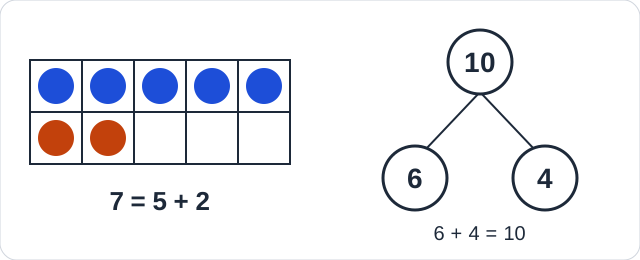
Seven is five and two on the ten-frame; ten is six and four in the bond.
Place value. A child can write 34, read it as "thirty-four", and still see a three next to a four. Ask what the 3 stands for. "Three" means the idea has not landed yet; "three tens" means it has. Bundle straws with elastic bands and say "three tens and four ones" alongside "thirty-four" for a while.
Mental strategies. Many children hold up eight fingers for 8 + 5 and count five more. That is a fine start, but at ten, facing 48 + 37, fingers will not do. The article describes the strategies that replace them: make ten, doubles and near-doubles, adding a friendly number (36 + 9 is 36 + 10 − 1), and jumping along a number line. For subtraction the helpful idea is the gap: in 52 − 47, the distance from 47 to 52 is plainly five. Ask "How did you get that?" before you correct anything.
Times tables and word problems (Grades 2 to 5)
Memorise or understand? Parents ask this as though the two were rivals. The article's answer is both, in an order. Start with meaning: equal groups, arrays, jumps on a number line. The array matters most, because turning three rows of four on its side shows that 3 × 4 and 4 × 3 give the same total, which halves the facts to learn. Then build the tables through patterns: twos, fives and tens first; fours and eights as doubles; sixes as doubles of threes; nines as ten times a number minus the number (9 × 7 is 70 − 7); sevens last, because nearly every seven fact has already appeared.
As a rough guide: 2, 5 and 10 by the end of Grade 2 (about age 8), 3, 4 and 8 during Grade 3, everything up to 10 × 10 by the end of Grade 3, and 12 × 12 in Grade 4 where your school teaches it. Practise little and often: five minutes a day beats an hour on Sunday. If your child dreads timed practice, play multiplication war with cards instead.
Reading the maths in word problems. A child who adds and subtracts perfectly on bare numbers can stare at a story problem as if it were another language. Usually the trouble is the reading. Only one of the five things a word problem asks is arithmetic: reading, picturing, choosing the operation, calculating, and checking. The article warns against key-word tricks: "Sam has 5 marbles, which is 3 more than Ben" contains "more" but needs subtraction.
Instead it offers seven habits: read it twice, find the question, draw or act it out, know the few types of story, estimate first, label the answer ("7 stickers", not "7"), and reread. Writing your own problems helps too: ask for a story for 3 × 4, then swap.
Fractions without a rule to memorise (Grades 1 to 5)
Fractions start with fair sharing. Ask a four-year-old to share a biscuit and they will break it in two and compare the pieces. If one is bigger, there will be objections. That is the central idea already: equal parts of a whole. Let your child cut a sandwich and check whether the pieces fit exactly on top of each other. Fold paper in half and in half again to find that half of a half is a quarter. Ask "half of what?", because half of a small pizza is not half of a large one.
Comparing fractions. Ask which is bigger, 3/8 or 2/5, and many adults reach for a rule and some freeze. Children can reason their way there. Same denominator: compare the numerators. Same numerator: the larger denominator means smaller pieces, so 3/4 beats 3/8. Use benchmarks: 3/8 is below a half and 4/7 is above, so 4/7 is greater with no calculation. Ask how far each is from a whole: 7/8 is missing only an eighth, 5/6 is missing a sixth, so 7/8 is closer. When nothing else works, cut both wholes into the same size of piece.
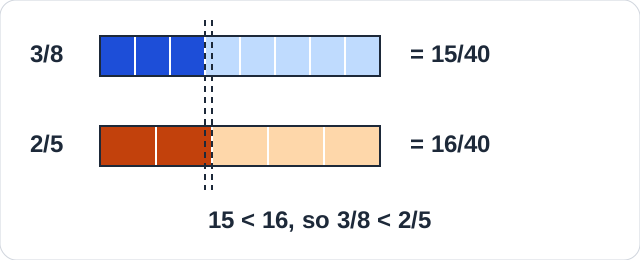
In fortieths, 3/8 is 15/40 and 2/5 is 16/40, so 2/5 is a little longer.
The most common error is thinking 1/8 is bigger than 1/6 because 8 is bigger than 6. Counter it with "Would you rather share a pizza with 6 people or 8?" Rules are fast once understood, but a rule learned without understanding is easy to forget.
Measuring, money and time at home (Kindergarten to Grade 4)
Measuring in the kitchen and the garden. Measuring is comparing something with a unit of the same kind. Children usually get there in four stages: direct comparison, comparison through a third object such as string, non-standard units like footsteps and paperclips, and finally rulers, scales and jugs. A big hand-span gives a smaller number than a small one, which is why standard units were invented.
Try lining sticks up with one end level before saying which is longer, starting a ruler at the zero mark rather than 1, weighing flour on a dial scale, and charting a sunflower's height each week. Watch for "it's 3 long" (3 what?) and for believing bigger means heavier: a balloon is light and a small stone is heavy.
Coins, change and shopping. Money is where children meet place value, counting on and decimals all at once. Point out that size does not match value: a dime is smaller than a nickel but worth more. Count mixed coins from the biggest value down, and ask how many ways make 25 cents (a quarter, or two dimes and a nickel, or five nickels).
Change is where the best idea lives. Do not subtract; count up, the way a shopkeeper does. An item costs 65 cents and the customer pays a dollar: 65, 70, 75, 100.
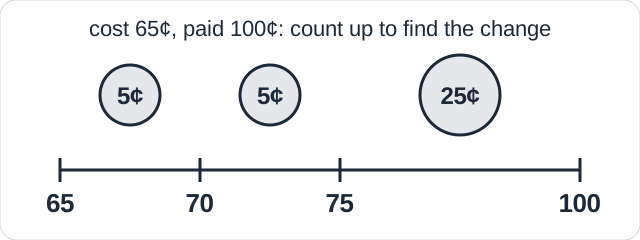
The coins handed back are the change: 5, 5 and 25 cents.
The examples use dollars and cents. Canada stopped distributing the penny in 2013 and rounds cash totals to the nearest 5 cents, so penny examples apply to the US or to "when pennies are available". The same ideas work with any currency. With prices like $2.35, be explicit that the two digits after the point are hundredths of a dollar.
Telling the time. An analogue clock shows time as a quantity: you can see how much of the hour has gone. The order we suggest is the hour hand and "o'clock", then half past, then quarter past and quarter to, then minutes in fives, then single minutes. Half past is the first time the hour hand does not point exactly at a number: at half past three it sits halfway between 3 and 4.
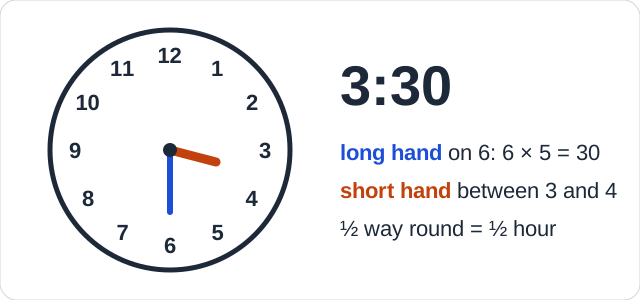
Half past three: the long hand is half way round, the short hand is half way between two numbers.
Check that counting by fives is secure before the minutes step, since the number on the face is not the number of minutes. Many children find "to" harder than "past". A paper-plate clock with a split pin makes a good practice tool, and so does "It's quarter to eight and we leave at eight: how many minutes do we have?"
Shapes and position (ages 3 to 8)
Early geometry is less about naming shapes than about looking carefully. Count sides and corners, sort a mixed set any way your child likes, and show triangles that are tall, wide or upside down, because many children think a triangle must point upwards.
For position, words are the heart of it: under, between, next to, behind. Left and right are among the hardest and often take until six or seven to settle, so be patient. A robot game with cushions and chairs ("forward three steps, turn left, forward two") teaches precision and sequence. Around age 7, a grid with a treasure on one square introduces "two across and three up".
Progress that is clearer for parents
Three things that used to need a little effort from you now take care of themselves.
Enter a birth year, not a grade. When you create a child, or correct a profile later in the parent area, you now type a four-digit year of birth. The app works out the school grade from it. The school year starts on 1 September, and a child is in Grade 1 the year they turn six. A child born in 2019 is in Grade 2 in autumn 2026, and moves to Grade 3 on 1 September 2027 without you doing anything. Children under six are shown as pre-school, and the grade stops at 5. A year in the future is refused with a clear message. Children you created earlier keep the grade you chose until you add a birth year, and older exported files still import fine.
A parent overview that is never empty. The parent area now opens on one overall spider web with an axis per subject. It shows where your child is today next to where a child of their grade is expected to be, even before anything has been practised. Each subject also has its own web. Below sits a short progress report, like a school report: for each subject, the grade, today's date and a plain-words summary. Before any practice, it says there is nothing to report yet.
A score on every activity. Until now the score lived on the skill, so two activities for the same skill showed the same number. Each activity now shows its own score, such as 7/10, based only on its own questions. The skill score is a weighted average of its activities. Counting in order is the example: "1 to 10" counts twice as much as "1 to 5". An activity not played yet counts as 0%, so a skill is only fully scored once all its activities have been tried.
Skill: Count in order
  1 to 5   weight 1   score 100%  ->  1 x 100
  1 to 10  weight 2   score  50%  ->  2 x  50
  skill score = (100 + 100) / 3 = 67%
The skill score is shown as a percentage with a small info button that explains how it was calculated. Subject and topic totals use the same scores, so the percentages at every level agree, and "Passed" and "Not yet" always match the score beside them.
Who we are, what we collect, and where ads will never be
There are now Privacy, About, Contact and Terms of use pages, in English and French, linked from every footer.
The privacy page says what the site does with information, and the answer is mostly "nothing": there are no accounts, and children's practice results stay in your own browser on your own device. It names the few outside services involved. The About page says who runs the site and how the articles are written. The Contact page gives a real address for questions, corrections and mistakes in an activity or article.
The Terms of use page is written in plain language. It is a free educational site, and a child should use it with the knowledge of a parent or guardian. Personal, non-commercial learning at home or in a classroom is welcome: print pages, share links, quote short extracts with a link back. Please do not copy the activities, articles or code to republish elsewhere, or overload the site. We work hard to keep activities correct and suited to their grade but cannot promise they are free of mistakes, and the site does not replace a teacher or a school programme.
Advertising, and where it will never be. To keep the site free we are applying to show a small amount of advertising, with strict rules of our own. An ad can appear only beneath an article written for adults, or beneath the lists of skills and activities that parents browse, and only when the page has real reading on it. Never on the home page, in the parent area or in the documentation, and above all never inside an activity or on any screen where a child is answering questions. Ads are marked as advertisements, there is at most one per page, and they are the plain, non-personalised kind. In Europe, the United Kingdom and Switzerland you are asked for consent first, and you can change your mind from the Privacy choices link at the bottom of the page. The tool that counts which adult-facing pages are read is switched off wherever children practise.
Smaller changes you may notice
The site has thousands of skill pages, and most used to hold little more than a title. We have asked search engines to leave those alone until each has something worth reading, and we are filling them in one subject at a time. This week the first six kindergarten counting skills gained a proper explanation in both languages: what the skill means, things to try at home, and typical mistakes.
The home page now has a how-it-works section and a short list of common questions, and the site loads faster on a first visit because the parent area, practice screens and documentation are fetched only when someone opens them. The blog and documentation had also stopped appearing on the live site because their publishing step was failing silently. That is repaired, and the live site is now checked after every release.
If something looks wrong, or you would like an article on a topic we have not covered, please write to us from the Contact page.